
How New Zealand can go beyond mining and move up the critical minerals value chain

Updated: Apr 20
Critical minerals are top of mind for governments around the world today.
‘Critical’ for the function they provide in this age of electrification and AI, these minerals are also critical for another, more strategic reason: few nations can transform these raw mineral resources into value-add, industry-ready materials.
If the capability to process and refine remains offshore, the real strategic value does too: onshore supply (=resilience), high value products (=competitiveness and innovation) and high skilled jobs (=attractiveness and economic prosperity).
Strategic value is intrinsic to a mineral’s ‘criticality’, but is ceded to those who can process and refine it. This leaves those who are merely resource holders locked in at the bottom and beholden to buying back value-added products from those further up the value chain.
In this article, we’ll look at why simply having critical mineral deposits does not equal resilience. Then we’ll explain how novel processing technologies, like Aspiring Materials’ Aspiring Process, can transform raw critical mineral resources into high-value products that underpin domestic and regional value chains and deliver improved economic and social outcomes.
To highlight the benefits of our technology, we’ve used magnesium, nickel and silica as our real-world examples.
Magnesium: why processing it matters more than mining for it
This abundant mineral plays a strategic role for nations with use in everyday and specialised industries, including wastewater treatment, agriculture and aerospace.
Magnesium is a prime example of why localised processing creates a strategic advantage.
Geologically speaking, there is a global abundance of magnesium, but not all of it is in a readily accessible form.
Most of the world’s magnesium today comes from dolomite and is mainly processed in China using the Pidgeon process. This is a simple yet energy-hungry technique that requires high heat and releases significant greenhouse gas emissions, making it a problematic process as the world strives to decarbonise.
In New Zealand, we derive magnesium from talc-magnesium (magnesite) ore deposits. But without local processing capability, this raw resource is shipped offshore (primarily to China) to be processed and refined using the Pidgeon process. That means our agricultural and industrial sectors must buy it and have it shipped back again as an industry-ready material, at a value-added price.

New Zealand currently imports twice as much refined magnesium as it exports in magnesite, purchasing mostly from China.
Refinements to the traditional Pidgeon process over time have attempted to improve sustainability and reduce emissions from magnesium production. But the negative factors remain – high emissions are released because the process requires high heat.
For New Zealand to continue to access magnesium made via the Pidgeon process, we must bear the negative environmental impact and a long, fragile supply chain.
However, another source of magnesium available in New Zealand (and nearly everywhere around the world) could remove this trade-off: olivine-rich rocks.
Under Aspiring Materials’ Aspiring Process, magnesium can be readily accessed from this abundant source, cost-effectively, locally and cleanly.
Novel, onshore processing technologies, such as the Aspiring Process, are prime examples of how a nation’s strategic role can be shifted from a resource-supply status to a value-chain partner. Providing a clean, domestic, low-emissions source of magnesium will not only reduce our import dependency, but it will also facilitate faster decarbonisation and industrial innovation.
Nickel: how adding value to it asserts active participation in the energy transition
In the energy transition from fossil-fuel sources to electrification, nickel has a critical role in high-performance batteries, providing the density required for energy endurance.
Mining for nickel has largely been an environmental tragedy, where the presence of nickel mines has contributed to habitat destruction, mass deforestation as well as water and air pollution for communities adjacent to the mines.
As with magnesium, there are technological innovations that can reduce the environmental impact of these existing mining practices, but high demand for the metal could mean rising demand may outweigh pressure to improve practices.
This demand pressure comes from nickel’s integration into EV batteries and large-scale energy storage systems (e.g. for renewable energy grids) that require high purity ‘Class 1’ nickel.

For nickel’s battery application, it must be chemically combined with manganese and cobalt to form NMC (nickel-manganese-cobalt) or with cobalt and aluminium to form NCA (nickel-cobalt-aluminium) cathodes. This additional processing demonstrates that supplying nickel in its base form is only at the start of the value chain.
New Zealand does not currently mine for nickel, but olivine-rich rocks provide a solution with their small but high-purity nickel content, with cobalt and manganese also naturally present.
Yet, if we set our sights only on mining for this metal, we risk missing the bigger opportunity to build value and retain a level of control in the energy transition.
Aspiring Materials’ Aspiring Process separates out the nickel in a mixed-metal hydroxide form from the olivine rock. This mixed-metal hydroxide already contains manganese and cobalt, resulting in the valuable NMC hydroxide.
By expanding local capability to refine olivine-derived nickel into battery-grade NMC hydroxide, we increase its value as an export material, while also positioning New Zealand as a capability contributor in the energy transition, not just a resource supplier.
As with magnesium, local supply also equals easier access for local R&D and innovation. That spurs new ventures and provides pathways for new careers and industries domestically, which in turn strengthens our regional position.
Silica: how local processing elevates the nation to a low-emissions materials hub
Cement manufacturing is known to be a major contributor to global CO2 emissions, yet the material is essential for our infrastructure and buildings. There are numerous low-carbon cement manufacturers around the world today, with varying techniques to reduce emissions while retaining the high-strength and durability characteristics demanded of concrete.
Locally, New Zealand has a small but significant cement industry and has committed to a 30% reduction in CO2 emissions by 2030. The 15% reduction achieved to date is, in part, due to the use of supplementary cementitious materials (SCMs), which replace the traditional, high-emissions Portland Cement used as a binder in conventional cement mixes.
In New Zealand, SCMs under trial or in use include volcanic ash, waste material from either steel manufacturing (blast furnace slag) or coal combustion (fly ash), or silica.
Silica used as an SCM is presently derived from silica fume (a by-product of silicon metal production), and the majority for sale in New Zealand is imported from China and carries a high cost.
Demand is forecast to increase for sustainable, low-emissions cement in the coming years, but as the industrial sector works to decarbonise, this coincides with reduced availability of some SCMs due to electrification and recycling initiatives (fly ash and blast furnace slag) at these industrial production sites.
With the availability of SCMs declining as cement demand increases, a locally produced reactive silica can help to secure local supply, lower emissions and build resilience into local industry.

From the Aspiring Process, we separate out a reactive silica from olivine-rich rock. This material meets NZ, US and EU specification standards for use as an SCM and carries very low embodied emissions.
By locally producing SCM for both domestic and regional markets, New Zealand can elevate from a quarry-based economy to a low-carbon industrial materials hub.
Resilience comes from critical mineral value chain systems, not single commodity plays
Traditional mining is a targeted operation. A small fraction of mined material is the targeted mineral, with most of the mined material rejected as zero- or low-value waste or tailings. Sometimes these tailings can be used as inputs to other processes, but these often don’t attract or create value overall.
With novel processing technologies, such as the Aspiring Process, waste from domestic mining operations can become inputs that create economic value and retain economic opportunity, onshore.
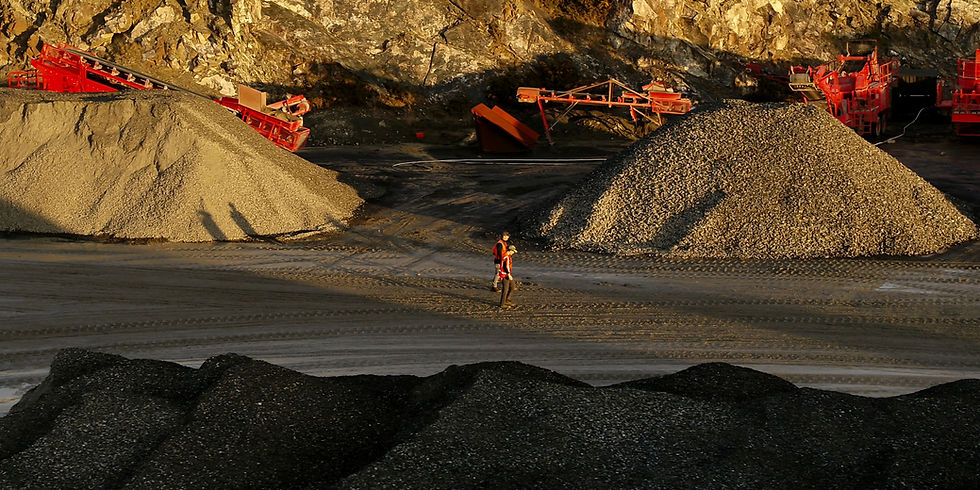
Currently, olivine-rich rock in New Zealand is considered mining waste and used as roading aggregate. Yet this seemingly low-value material holds real potential for the local economy under the Aspiring Process.
This single streamlined processing technology creates multiple saleable outputs that will support the domestic and regional industrial ecosystem and reduce total overall import dependencies.
As so much olivine is already easily accessible, resource prospecting for the Aspiring Process is negligible compared to traditional mining. Hard infrastructure does take time to build, but lead times to realised value for an olivine processing and refinement plant are much shorter when compared to mining operations.
As demand for critical minerals increases globally, building local production and refinement capability is necessary to protect our local industries from international price shocks, supply chain issues, geopolitical shifts and obscured environmental practices.
New Zealand has a growing cleantech ecosystem and we keep good company with other novel mineral processing ventures who are also building value-add propositions for critical mineral supply.
Of course, our nation cannot do it all. We must be selective to gain strategic advantage in the processing and refining sector. We must choose to process and refine minerals used domestically and regionally, those that offer emissions reductions at an industrial scale, support circularity and are aligned with the energy transition.
If New Zealand gets it right, the payoff will be transformative. A domestic mineral production sector will spur innovation in materials and industrial processes, reduce supply uncertainty and build a highly skilled workforce that will offer resilience in the AI era.
The potential for New Zealand to become a leader in modern mineral production and refinement is exciting. A systems-led cleantech refining sector offers our domestic economy unprecedented opportunity to create the economic and strategic value we seek for our future.
The Aspiring Process, developed by Aspiring Materials is already operating at pilot scale in Ōtautahi Christchurch New Zealand, capable of processing up to 250kg/day of olivine rock. This rock is found in abundance in New Zealand and across the world and a vast quantity has already been extracted from other mining and quarrying activities.
Aspiring Materials is founded on the beliefs of self-sufficiency, resourcefulness and an obligation to contribute positively to our environments, our communities and our planet. The Aspiring Process aims to transform how critical minerals and materials essential to industry are made, reducing emissions across industrial operations and shoring up supply.
If you run an operation that seeks a secure, reliable source of magnesium, silica or nickel hydroxide, get in touch.



Comments